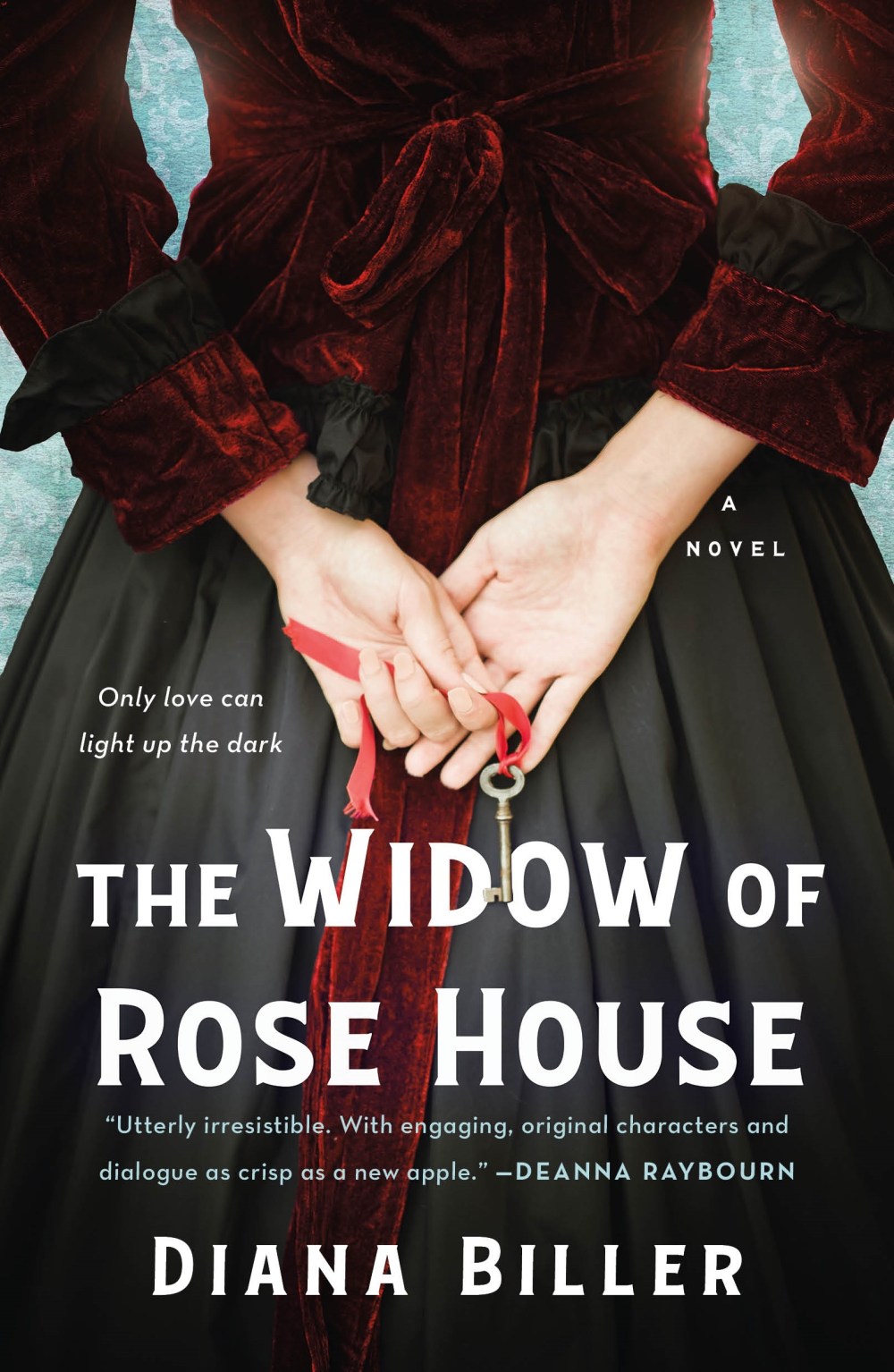
THE WIDOW OF ROSE HOUSE
By Diana Biller
Available on Amazon
Diana Biller’s debut novel, THE WIDOW OF ROSE HOUSE, is a gorgeous piece of prose, with a decidedly dark Victorian Gothic flair and an intrepid and resilient American heroine guaranteed to delight readers everywhere.
Prior to penning this novel, Biller had one idea in mind: “Edith Wharton, ghost hunter.” After touring Wharton’s estate, The Mount, and the Vanderbilt Mansion in Hyde Park, New York, she came away with a wealth of inspiration, and THE WIDOW OF ROSE HOUSE was born.
BLURB:
It’s 1875, and New York’s Gilded Age is in full swing. After fleeing her abusive husband, Alva Webster spent three years being pilloried in the newspapers of two continents. Now he’s dead, and she’s returned to New York to start over, restoring Liefdehuis, a dilapidated Hyde Park mansion for her new home decoration book and hopefully her reputation in the process. So when the eccentric and brilliant Professor Samuel Moore appears, threatening her fresh start with stories of a haunting at her house, she refuses to give him access. Alva doesn’t believe in ghosts.
A pioneer in electric lighting and a member of the nationally-adored Moore family of scientists, Sam’s latest obsession is ghosts. When he learns about a house with a surprising number of ghost stories, he’s desperate to convince its beautiful owner to let him study it. Can he find his way into her house…and her heart?
EXCERPT:
CHAPTER 1
New York City, February 1, 1875
Alva stood on the city sidewalk and sucked in a deep, triumphant gulp of air. The clock had just struck ten—the middle of the evening by New York City standards—and she was surrounded by elegantly dressed men escorting women dripping diamonds and rolled up tightly in furs. A few feet from her, the street was busy with carriages. She could smell the city: The damp fog, the sharp tang of refused, the high floral notes of perfumed women. Horse dung.
Had she missed it? She wasn’t sure, although she knew she missed the steep, tangled streets of Montmartre already. But it was America that held her future now, even as it held her past. For a second her triumph was tempered by the remembrance of the thin envelope in her pocket, a few brief lines from her mother’s secretary, thanking her for her interest in visiting and regretting that Mrs. Rensselaer would be unable to see her. Alva knew her mother, likely even now sitting down to a stiff dinner with her husband and twelve of their closest friends fifty blocks away, did indeed feel regret. She just suspected it was about giving birth to her at all.
“Excuse me,” a deep voice said. “Mrs. Webster?”
Oh, for heaven’s sake. Couldn’t she stand outside for one minute without some intrepid lothario assuming she must be waiting for him? In the less than seventytwo hours she’d been back in the States, she’d been propositioned eleven times. Twice by friends of her father’s.
She glanced over her shoulder at the man, receiving an instant impression of big, though he stood mostly in the shadows. “I don’t know you,” she said, her voice flat. “Go home to your wife.”
“But I don’t have a wife,” the man said. He took a hesitant step towards her, leaving the shadows, and her eyebrows lifted. He looked more like a laborer than a man finishing a dinner at Delmonico’s, for all he was dressed in a suit and tie. Sort of dressed, she amended; the suit looked like it had been made for someone two inches shorter and two inches narrower across the shoulders. “Do I need a wife to talk to you? Is it a chaperone sort of thing? I have a mother, but she’s in Ohio.”
Alva blinked. “You’re not very good at this,” she observed. “I’m not a man, but I don’t think it’s standard behavior to invoke one’s mother at a time like this.”
They stared at each other in puzzlement. He was attractive in the sort of way she’d always imagined the heroes of western folktales to be: tall, broad shouldered, with a strong nose and a square jaw. He could stand to add barber to the list of people he needed to see, though, the one that started with tailor. Actually, looking at the way his dark blond hair fell into his eyes, she thought he’d better have it start with barber and go from there.
“There’s been a misunderstanding, ”he said finally. “Perhaps if I introduce myself—my name is Professor Samuel Moore.” He held out his hand. She looked at it, looked up at him, and did not extend her own. Bafflingly, he smiled at her, as though she’d done something rather clever.
Was he really a professor? He certainly didn’t look like one, not that it mattered, because she made it a policy, these days, never to talk to strange men—
“A professor of what?” she heard herself saying, although she was pleased it at least came out with a nice air of sarcasm and disbelief.
“This and that,” he said, still smiling. “Engineering, mostly.” She looked at his rumpled clothes. Yes, she could see that, one of those men who always had a tool in one hand and a grease can in the other. She didn’t know they were giving professorships out to men like that, but why not, after all? She was as appreciative of things like trains and working carriage wheels as the next person.
And now she’d gone and encouraged him. Stupid. “I see,” she said as coldly as she could managed. “Well, I’m not interested, so I’ll wish you good evening.”
“But how can you know if you’re not interested?” He shook his head in confusion, still smiling at her. The smile was . . . impressive. “I haven’t even explained my proposition, yet.”
“I find that if you’ve heard one proposition, you’ve heard them all, ”she replied. Stop talking to him, you idiot. “They’re not as unique as men would like to believe.”
“But—who else has approached you? Was it Langley, from Yale?” His tone turned plaintive. “How did he hear about this before me?”
“Langley—who?” “Piers Langley,” he said. “No? I can’t think of anyone else reputable—look here, if you’ve been approached by anyone from that quack Santa Fe institute you should know they’re absolute frauds.”
“Institute?” Alva said faintly. “What on earth are you talking about?”
“Your house, of course. I hadn’t realized I was so behind on the news. ”His face fell—What must it be like to let all your emotions float freely on your face?—but he nodded gravely. “If it’s Langley, though, he’s an excellent researcher, and a decent human, too.”
“It’s not Lang—what do you want with my house?” It was her turn to sound plaintive.
“But that’s what—” He stared at her, his brows crunched together. “Oh god. I wasn’t—I wouldn’t—”
To her astonishment, a distinct touch of pink appeared in his cheeks. He cleared his throat.
“I beg your pardon, ma’am. Henry warned me—that is, I shouldn’t have; my proposition is not of an intimate nature.”
“I’m coming to understand that,” she said. “You thought . . . do men . . . they must—good lord.”
She began to feel in charity with this befuddled giant. “Indeed,” she said. “I quite agree. But I must ask again—what is it you want with Liefdehuis?”
“To study it,” he said. “One of my personal interests is in metaphysical energies, you see, and from what I’ve heard, your house may prove a most interesting case. Your ghost story is so recent, you know. I hardly ever hear one claiming to be that new—”
He broke off as she shook her head. “You almost had me convinced that you were unlike the majority of your sex,” she said. “And now I see you are. I’m just not sure insanity is much of an improvement.” To her surprise, he smiled again. “You’re not the only one who thinks so,” he said. The embarrassment had left his face; he was quite relaxed once more. A man who apologizes for a proposition and grins at an insult, Alva thought. Where did you come from, Professor Moore?
“And I’ll admit there’s no conclusive evidence yet,” he continued, “but what I have collected looks extremely promising. Certainly promising enough to warrant extensive study.”
A hint of cold pierced her thoughts. Firmly, she banished it. “You’re talking about ghosts,” she said.
“Maybe,” he replied. “Or I could be studying some kind of alien intelligence that just happens to concentrate in areas corresponding to local folklore.”
“Alien intelligence.” “Invisible alien intelligence,” he clarified. “At least invisible to the naked human eye. But ‘ghost’ is probably the easiest term.”
“Really.”
“People tend to go a bit strange when you talk to them about invisible alien intelligences,” he confided. “Which is odd, when “Invisible alien intelligence,” he clarified. “At least invisible to the naked human eye. But ‘ghost’ is probably the easiest term.” you think about it, because why are the shades of one’s dead ancestors any less unsettling?”
She found herself nodding before the rest of her wits caught up with her. “No,” she said, not because the word corresponded with any particular question, but because she had the feeling the only way to survive here was to stick to very black and white words. His nuances were both compelling and sticky. “I’m afraid I won’t give you access. I don’t believe in ghosts, and I’m about to start several months’ worth of building work.”
“Don’t decide yet,” he begged. “I’m willing to pay you for the privilege, and I promise I won’t be in the way . . .although there is rather a lot of equipment, so I suppose—”
The boy hailing cabs caught her eye and gestured as a hansom pulled up beside him.
“Wait!” he said. “I’ll—I’ll send you a letter. Henry said that was the way to do it—I’ll write you and explain more.”
“It won’t help,” she said as the cab boy helped her into the carriage. “I’m sorry. Goodbye, Professor Moore.”
Finally, he sighed acceptance and raised his hand. “Good evening, Mrs.Webster.”
As the cab pulled away from the sidewalk, though, she looked back at him, to find him staring after her with his hands shoved in his pockets and that apparently irrepressible grin backin place. An uncomfortable lightness expanded in her chest as she watched him standing head and shoulders taller than the passersby around him, looking back at her as though he would be perfectly happy never to look at anything else ever again.
What couldn’t I get, if I could look at people like that? she thought, and settled grumpily back against her seat.